skip to main |
skip to sidebar
Today we received a request from a fellow non-profit, Defenders of Wildlife, to help save loggerhead sea turtles in the Gulf of Mexico. Defenders of Wildlife is working to increase protections for these sea turtles by listing them as endangered under the Endangered Species Act. Click here to take action now.
Loggerhead sea turtles were in trouble before the Gulf oil spill disaster. The number of female loggerheads nesting on Florida beaches – one of the most important habitats for the species – has declined by 50 percent in the past decade. Scientists and government officials have sounded the alarm about what this could mean for the future of the ancient sea mariners. The National Marine Fisheries Service is now proposing to upgrade protection for loggerheads from threatened to endangered under the Endangered Species Act.
These turtles need our help even more now. The world’s second-largest loggerhead nesting area is on the beaches of the southeastern United States, the vast majority of which includes Florida’s central Atlantic beaches.
This area is expected to be threatened by the horrific oil slick, depending on how much of the slick gets picked up by the Loop Current -- a powerful ocean current that could bring the slick around the southern reaches of the state, through the sensitive coral reef and mangrove areas of the Everglades and the Keys, and then into the Gulf Stream and up the east coast of Florida.
The spill could not have happened at a worse time: loggerheads and other sea turtles -- as well as many shorebirds -- are in the peak of their nesting seasons right now.
Oil is extremely toxic to loggerheads and other species. Exposure can cause skin loss, poisoning, drowning and death… which is exactly why we need every available tool to help save the lives of individual loggerheads and save this species from extinction.
If you’ve been following this blog, at some point you might have wondered at some point, what’s with all the animals? Isn’t this a river organization? And isn’t this blog supposed to be about a historic house? Are they just trying to woo me with cute animal pictures?
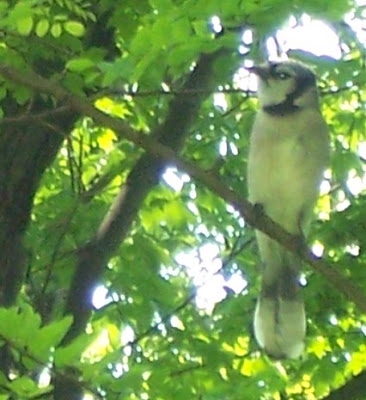
Well, on a really simple level, we do think it is kind of fun to follow and photograph all of the creatures who live around our home. And we hope you enjoy discovering along with us.
But beyond that, they prove an important point (or two). If twenty condominiums had been built on this property, between the construction process and the finished project, many (or most of) the animals we’ve documented would have lost their habitat. Sure, there’s a park next door, but you can only fit so many turtle or chickadee nests in one place. Members of many species (such as owls and hawks) don’t like to live too close together because they compete for limited resources.
Willow Hall also demonstrates that a surprising number of species can be found in suburban habitats. A research project conducted by two interns last summer found 17 bird species, 4 amphibians, 2 reptiles and 6 mammals live or pass through our property. Despite all that had been written about Willow Hall, no one had any idea of this before.
We think that’s pretty impressive for living on the fringe of an urban area such as Morristown. And there are probably more creatures living with us that we haven’t found yet. This summer we would like to begin the process of applying for a Wildlife Habitat Certification for Willow Hall through the National Wildlife Federation. (We’ll have more on that in another post.)
Protecting wildlife habitat is also important to the Passaic River Coalition for a few reasons. Many species, especially amphibians, turtles, and fish, can give us clues about the quality of water in streams, rivers, and wetlands. Habitat that’s healthy for animals is usually healthy for people as well. And protecting predator species also helps keeps other less desirable populations in check. It is much better for our waterways to let birds and bats control the mosquito population than to drain wetlands or douse them with pesticides.
And to us, the world is a richer place because of all the other creatures who share it with us.
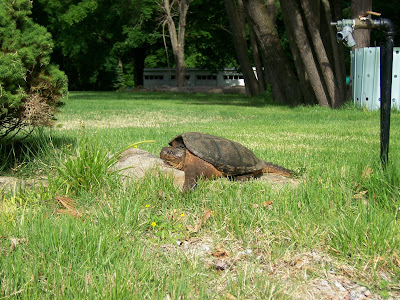
A snapping turtle sunbathing on the lawn this morning

We didn't get any blue birds in our three blue bird nest boxes at Willow Hall this year. (They don't seem to have moved into the nest box at Highlands Meadow either.) But we did get a pair of chickadees who moved into the box closest to the house. It seems their young have just hatched since the parent's activity has picked up significantly. They've been flying in and out of the box all day, making it much easier to take this photo through the window.
Initially, female chickadees spend most of their time incubating the eggs while the male bring food. But once the eggs hatch, both parents take turns feeding the young who should fledge in 14 to 18 days. Chickadees are omnivorous, eating insects, seeds, and berries.
Last Friday Passaic River Coalition staff met a new resident at Willow Hall. Our newest tenant is a female painted turtle who decided that the dirt driveway to the garage in the backyard would be a fine place to lay her eggs.

We were a bit surprised to find a turtle laying eggs so far from the lake and up quite a large hill. But if she was bothered by us, she didn't show it. We watched her for over half an hour, bobbing her head in and out of the shell and using her feet to push dirt back into the hole she had dug (you can see the little dirt mound in the photo below). While we weren't able to count, we have read that painted turtles can lay between three and twenty eggs, depending on the size of the mother.

She won't actually be a permanent resident of our backyard; once the eggs are laid painted turtles leave the nest alone and go about their business of being turtles. The eggs will incubate 65-80 days and then they'll hatch. Though some of the life histories we read said that in some parts of the country, the turtles will actually stay underground all winter and then emerge in the spring. That's quite a wait to see if anyone will hatch. Too bad we can't charge for babysitting.
We will be keeping an eye on the area, it's currently marked with a bale of straw so no one is driving over it.


